
Sheet metal fabrication tolerances define how much a part may deviate from your drawing. They decide fit, function and cost. Tighter tolerances need more process control and higher cost. This guide explains what drives tolerances in sheet metal work. It also shows how we confirm them before production.
What Are Sheet Metal Fabrication Tolerances?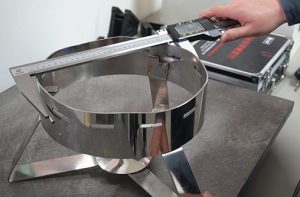
Tolerances are the allowed limits on a dimension. A drawing sets a target size plus an allowed range. The part passes if it measures inside that range. Every process has its own natural tolerance band.
- Tolerances guide assembly, function and cost
- Tighter limits need more controlled processes and more inspection
- Loose limits reduce cost but may affect fit
Why Tolerances Matter
Tolerances decide whether parts assemble and work. A bracket with wide tolerances may not fit its mating part. A housing with tight limits costs more to produce. Good drawings focus tight tolerances on critical features only.
- Assembly depends on controlled dimensions
- Function and safety rely on critical features
- Cost rises when tight limits spread across many features
Tolerances by Process
Each fabrication process has its own tolerance behavior. The notes below explain what drives accuracy in each one.
- Laser cutting — profiles and holes follow the program closely; accuracy depends on thickness and edge conditions
- Bending — angles depend on material springback, tooling and bend length; the first article sets the reference
- Stamping — die quality sets repeatability; high-volume parts stay consistent once the die is proved
- Deep drawing — wall thickness and roundness depend on draw stages and material flow
- Welding — welded assemblies usually carry wider limits than single parts; fixtures hold alignment
- CNC machining — drilled holes and threads hold close limits after forming
What Affects Achievable Tolerances
- Material type and temper — springback differs between aluminum, steel and stainless steel
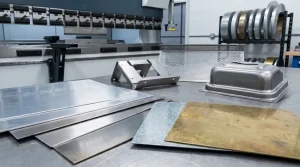
- Sheet thickness — thicker sheet behaves differently in forming and bending
- Part size and feature position — limits widen as parts grow larger
- Process sequence — each added step adds variation
- Tooling condition — worn tools drift over long production runs
- Finishing — coating adds thickness on finished surfaces
How to Specify Tolerances on Your Drawing
- Set tight limits only on features that matter
- Use a general tolerance block for everything else
- Stack dimensions from one datum where possible
- Allow for coating thickness on finished surfaces
- Ask for a tolerance review before tooling starts
How We Confirm and Verify Tolerances
This is where tolerances move from drawing to reality. We confirm achievable limits before production starts.
- Drawing review — our engineers confirm achievable tolerances per process
- First-article check — sample parts measured against your drawing
- In-process inspection — key dimensions checked during production
- Final inspection — critical features verified before packing
- Delivery — parts shipped with inspection records on request
Real Project Result
A representative project from our production history—over 70,000 different types of custom metal parts delivered to date:
Multi-bend mounting bracket for motorcycle equipment
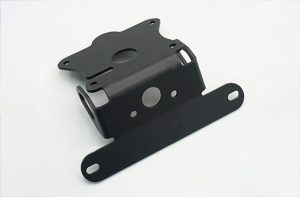
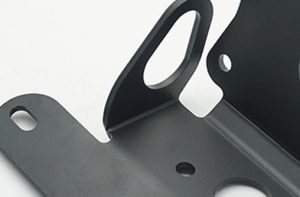
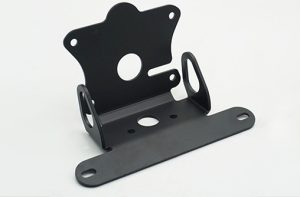
A motorcycle accessory maker needed a mounting bracket with several bends and mounting holes. The holes had to line up after bending, and coating thickness had to fit the tolerance budget. Our engineers planned the sequence before production.
- Part: multi-bend mounting bracket, powder coated
- Process: laser cutting → bending → powder coating → dimensional inspection
- Key challenge: bend angles and hole positions stacking up, plus coating thickness on finished surfaces
- Our solution: press-brake tooling plus first-article verification, with coating thickness allowed in the drawing
- Production: 2,000 pcs per order
- Quality result: hole positions and bend angles verified per drawing; assembly fit confirmed
Frequently Asked Questions
What is a normal tolerance for sheet metal fabrication?
It depends on process, material and part size. Laser cutting and machining hold closer limits than welding. We confirm practical limits for your part during review.
Can you work to my drawing tolerances?
We review your drawing first. Our engineers confirm which limits we can hold. Any conflict is raised before production.
Do tighter tolerances cost more?
Yes. Tighter limits need more process control and inspection. We help you focus tight limits on critical features.
Do you provide inspection records?
Yes. Dimensional reports are available on request. Critical features are checked in-process and before shipping.
Act Immediately! Please Hand Over Your Project To Us!
Ready to discuss sheet metal fabrication tolerances for your part? Get a quote from Weizhi today.
Send your drawings in any format—2D, 3D or photos. Our engineers will review them for free. You will receive pricing and lead time within 8 hours.