
Sheet metal vs aluminium die-cast enclosure matrix
| Factor | Sheet metal | Aluminium die casting |
|---|---|---|
| Tooling cost | Low/zero for standard bends | High die cost, amortized at volume |
| Best volume | Prototype to under 5,000 | Typically above 10,000 |
| Wall thickness | About 0.8–3 mm, design dependent | About 1.5–4 mm, design dependent |
| IP protection | Excellent with formed seams and gasket | Excellent with machined gasket faces |
| Heat dissipation | Good; add fins or heat spreader | Very good; thin integrated fins possible |
Most enclosure projects come down to two questions before anyone talks about money: how thin the wall has to be, and how tight the fit has to be. That is why the sheet metal vs casting choice is usually settled early. A formed part is cut from flat stock, so the wall is as thin as the sheet and no mould has to be paid off. However, casting wins a different argument. It makes sense when the enclosure needs a thick, rigid, complex three-dimensional form. It also makes sense when the volume is high enough to spread the tooling.
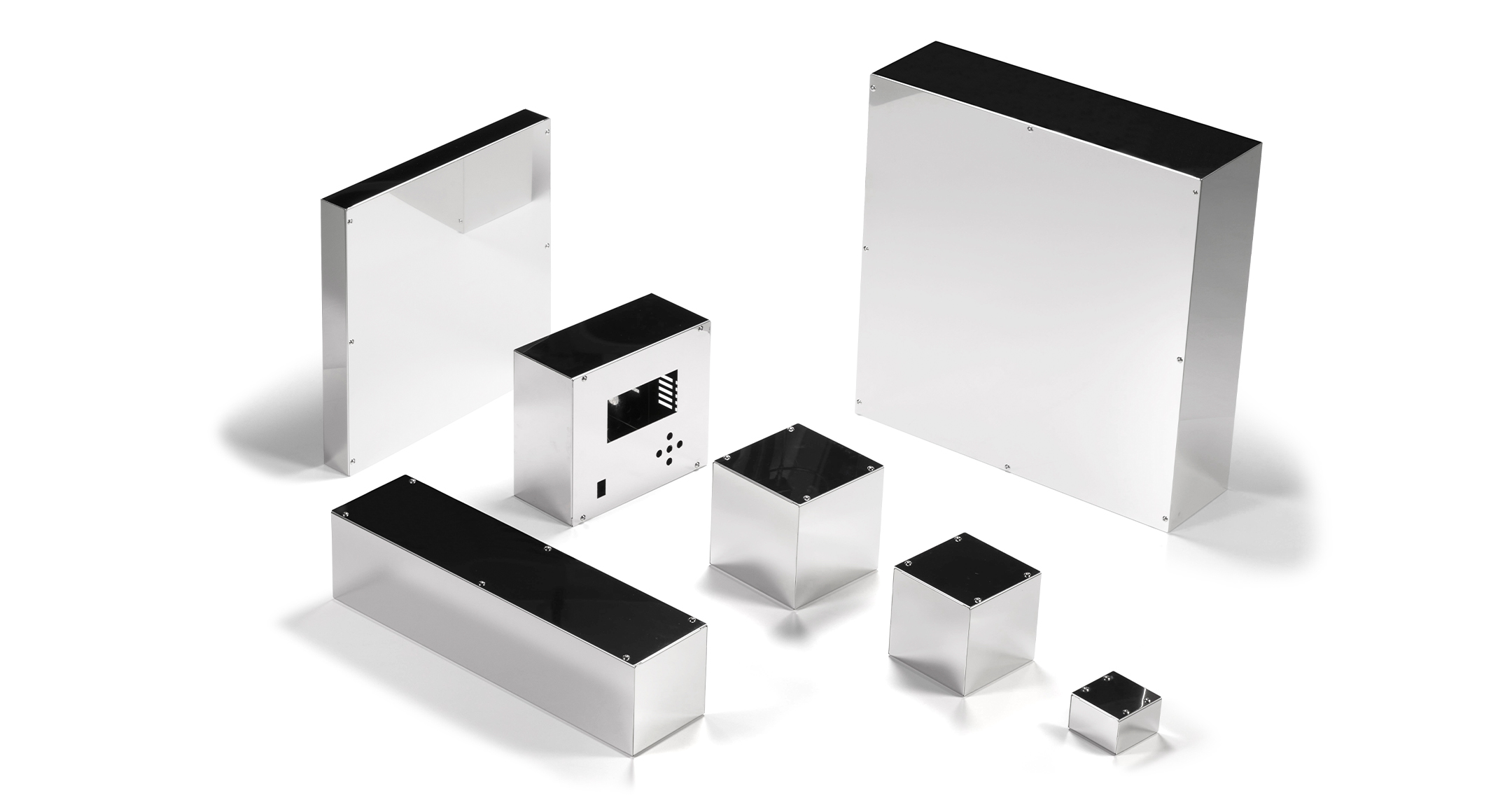
The short answer
| Deciding factor | Sheet metal fabrication | Casting |
|---|---|---|
| Tooling before the first part | None — cut and formed from the drawing | A pattern for sand casting, or a die for die casting |
| First part economics | Single units are practical | Sand casting takes low volume; die casting needs volume to pay off the die |
| Dimensional tolerance | We hold ±0.5 mm on critical formed features | Graded by ISO 8062-3; sand casting sits in the coarser grades |
| Wall thickness | Thin by construction — the wall is the sheet | Must be thick enough for metal to fill the mould |
| Design change after the first part | No tooling to change | Needs a tooling change |
| Prototype turnaround | Samples within 72 hours, without moulds | Pattern or die first |
| Surface | Powder coat, paint, brushed or anodised | As-cast texture; flat, sealed faces usually need machining |
| Reinforcement where it matters | Ribs, gussets and bosses added as formed or welded features | Ribs cast in one piece |
Wall thickness is the first fork in the road
An enclosure is usually a shell: a box, a cover, a chassis, a panel. In sheet metal the wall thickness is a material choice, and the shape is what varies. Draw depth, wall angle and corner radius are the three values we tune against the drawing. In casting the wall has to be thick enough to let molten metal fill the cavity before it freezes. That pushes the whole design toward a heavier section.
So the question is rarely “which is stronger”. It is closer to this: does the enclosure have to be thin, light and accurate, or thick, rigid and self-supporting?
Tolerance: where the two routes split
Casting tolerances are not one number. Instead, the ISO 8062-3 system grades them by process and by nominal size. Sand casting lands in the coarser grades, and that is the nature of a mould made from a pattern. On the formed features of a sheet metal part we hold ±0.5 mm on critical dimensions. We also check the first piece against the drawing before production starts, and we confirm corner radii and flange lengths at drawing review.
In practice, the result is simple. When an enclosure has to accept a PCB, a connector cut-out or a mating panel, tight dimensions are the requirement. Formed sheet metal delivers them with no tooling step.
Tooling and minimum volume — where the cost leans
This part of the comparison often shrinks to “tooling costs money”, which is true but not useful. What matters is which way the cost leans at your volume:
- One-off and prototype: sheet metal, clearly. There is no tooling, and we produce samples within 72 hours without moulds, which shortens your own check cycle because a design change costs nothing in tooling.
- Small to medium batch: still sheet metal for most enclosures. The per-part cost is material plus machine time, and extra units add little.
- High volume, simple section: this is the band where a casting die can start to pay for itself, but only if the design accepts the coarser tolerance grade.
- High volume, tight tolerance: casting then has to be followed by machining, and that is where the sheet metal route usually stays competitive.
We quote one all-in price rather than splitting out an invented tooling figure, and there is no fixed minimum order. Laser and brake work starts from single units. If you need to compare routes, send the drawing and the annual volume, and we will compare them on your actual geometry rather than a rule of thumb.
Design changes are the hidden variable
Enclosures change. For example, a connector moves, a mounting hole shifts, a vent is added. On a formed part the change is a new program and no new tooling. On a casting it is a tooling change, so the design is effectively frozen once the die exists. If your project has any chance of a revision, that alone usually settles the choice.
Surface finish and sealing
Formed sheet metal takes powder coating, wet paint, brushing and anodising, and a metal-to-metal seam or a gasket lands on a flat face. A raw casting carries the texture of the mould, so any face that has to seal, sit flat or carry a gasket is normally machined. For an enclosure that must keep dust or moisture out, that is an extra step, and one more place where tolerance adds up.
When casting is genuinely the better answer
However, none of the above makes casting a worse process. It makes it a different one. Choose casting when:
- the part needs thick, load-bearing sections or internal ribs in one piece, which would be many welded or formed parts in sheet metal;
- the geometry is genuinely three-dimensional and organically curved;
- volumes are high and stable enough to pay off a die;
- the tolerance grade is acceptable as cast, or the critical faces can be machined at a fair cost.
If two or more of those hold, when casting beats sheet metal is worth pricing. If the enclosure is thin, accurate and likely to change, sheet metal is the shorter route to a working part. For the general-tolerance background behind both routes, ISO 2768-1 sets the four classes (fine, medium, coarse, very coarse) that many drawings rely on by default for linear and angular dimensions.
Frequently asked questions
These are the questions buyers ask most often about this comparison.
What is the minimum order for a custom enclosure?
There is no fixed MOQ. Laser cutting and press-brake forming need no die, so production can start from single units, and free samples are available for approved projects.
Can you produce a prototype without tooling?
Yes. We fabricate samples without moulds within 72 hours, which shortens the check cycle before volume production.
What tolerance can you hold on an enclosure?
On formed features we typically hold ±0.5 mm on critical dimensions. The first piece must pass full inspection of critical dimensions and shape tolerances before mass production begins, and we confirm draw depth, wall angle and corner radii at drawing review.
Do you hold ISO 9001:2015?
Yes. Quality runs to ISO 9001:2015, covering incoming material checks, in-process inspection and final dimensional checks before shipping.